Harnessing the Power of AI to Enhance OT Education
Heather Kuhaneck July 21, 2024
Among the many technological innovations shaping OT education, AI has the greatest power to completely transform how we teach. It is a game changer! Lets consider just some of the ways OT educators might use AI in their teaching. Many of these ideas will be explored further in future posts with “how to” instructions.
AI as Tutor
One of the exciting applications of AI for students, that will enhance learning for concrete topics such as anatomy and medical terminology is the use of AI as a tutor. AI algorithms can analyze a student’s strengths and weaknesses to tailor content and questioning to meet their individual needs. Imagine a student struggling with anatomy. AI can adjust the complexity of exercises, and even suggest resources or documents to enhance understanding. This personalized approach ensures that each student receives the support they need to succeed.
Intelligent tutoring systems (ITS) can provide real-time feedback and guidance to students as they work through clinical scenarios. For instance, an ITS could simulate a client with a specific condition and guide the student through the assessment and intervention process, offering hints and corrections along the way. This type of immersive, hands-on learning is invaluable in developing clinical reasoning skills and preparing students for real-world practice.
VR powered by AI
In person clinical simulation is ideal, but can be time consuming to create and set up and the logistics of scheduling can be difficult. A VR simulation, powered by AI, can supplement in person simulations and provide critical opportunities for practice over time.
These simulations, using VR powered by AI, can create realistic clinical scenarios that allow students to practice skills in a safe and controlled environment. These simulations can mimic a wide range of situations, from routine assessments to complex interventions, providing students with immersive learning experiences. AI can help educators with feedback and grading as well, as AI is able to track a student’s performance during these simulations, providing detailed analytics and feedback to help them improve.
AI role play
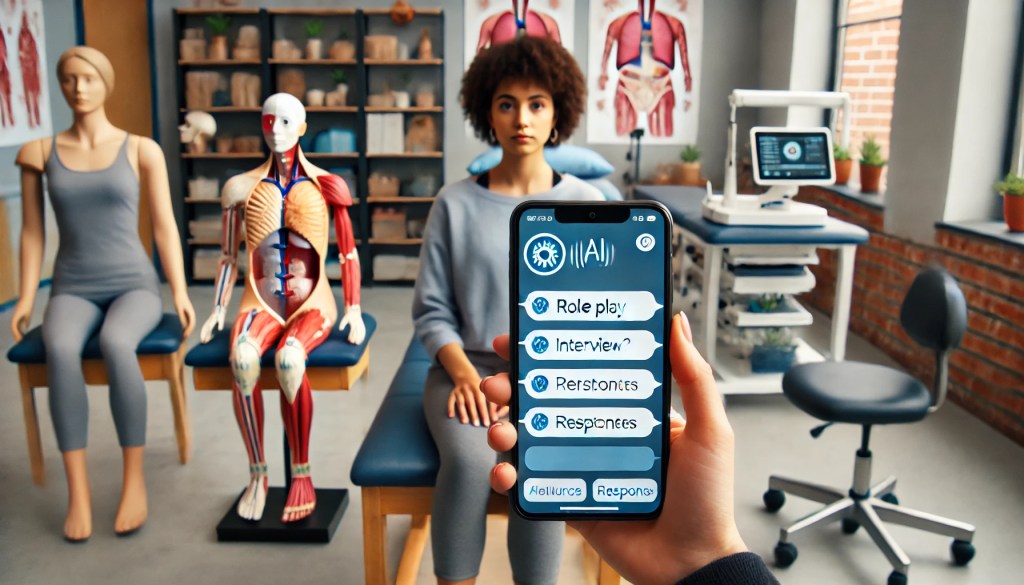
AI can be used to help students prepare for interviewing clients or for their first job. AI can role play with the student, responding to questions, or asking them. AI can critique the student’s responses and provide suggestions for better questions or answers.
Making history come alive
Using material available in speeches, written work, and on the web, AI can create characters from our past that can text chat with students. Want to chat with William Rush Dunton about what it was like to be the first AOTA president? With a few more steps, students could be having a video chat with an Eleanor Clarke Slagle bot, asking her about the early years of the profession.
Creating cases
OT educators routinely use cases in education and it can be time consuming to create them. AI can help by geting the case started, so that the educator just has to review and edit, supplementing where needed. “Next level” cases can be converted to generated character videos for students to interact with when it is not possible to have in-person experiences with specific clients.
Generating interprofessional learning experiences
AI can provide opportunities for students to practice in simulated team meetings with other professions. AI can help craft assignments for students to learn about the roles of the other professions or can help the students learn about the overlap between professions and where OT is truly unique.
Measurable goals and objectives
A trained bot created by an instructor, can allow students to practice their goal writing for measurability using whatever format the instructor selects (SMART goals for example). AI can critique their goals and provide suggestions for being more concise, more measurable, and more occupation focused.
Stay tuned for more
These are just some of the ways AI can transform how educators teach in OT. Stay tuned for upcoming posts where we will explore HOW to have AI do these things.
 The Wizard of OT
Leave a comment