Engaging Students in the Human Library within OT Education
What is a Human Library?
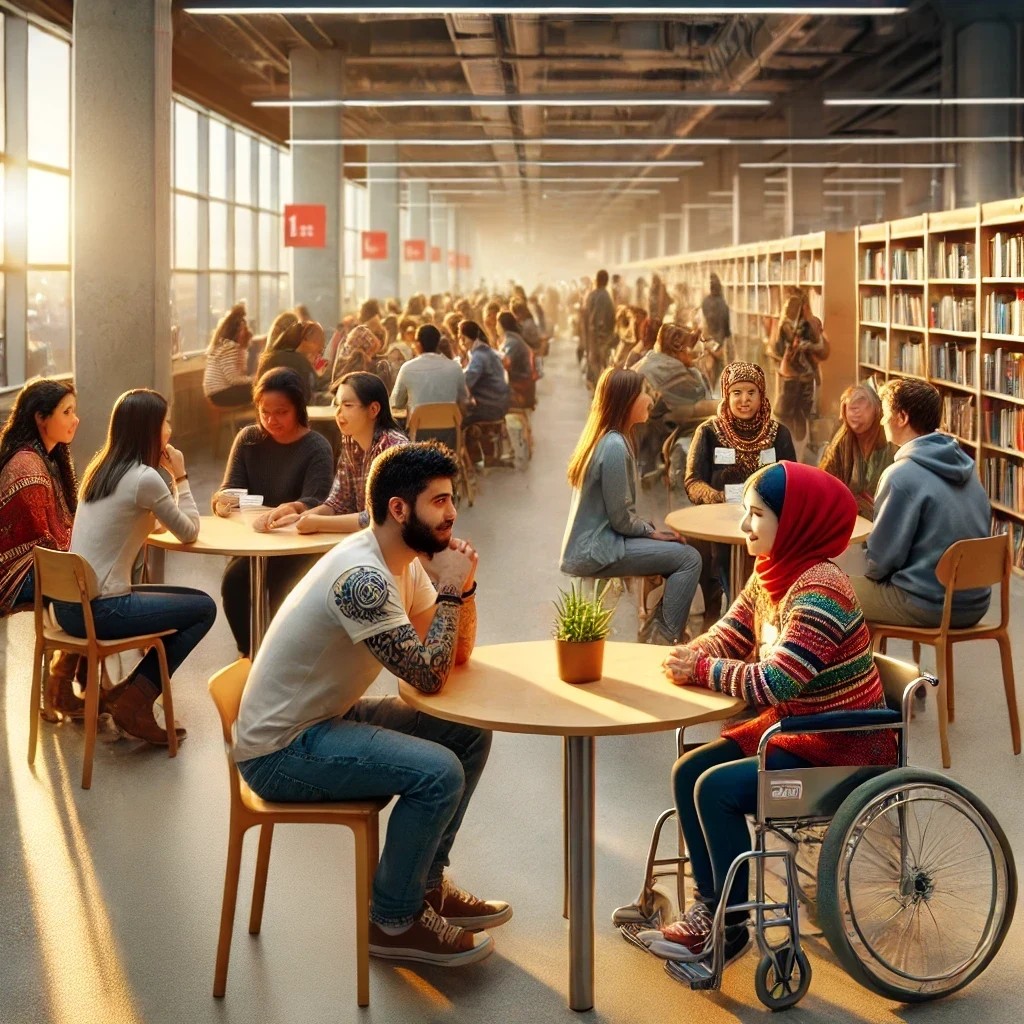
Imagine walking into a library where the “books” are people—real people, each with a powerful story. That’s the Human Library. It’s a movement that began in Denmark in 2000, designed to challenge stigma and prejudice through dialogue. Participants, often called readers, “check out” human “books”—individuals who have experienced marginalization or unique life journeys—and engage in open, respectful conversations. It’s empathy education on a whole new level. Each ‘book’ (person) is given a title that will describe the experiences they represent. For example, a book title might be ‘Anxiety’, or ‘Transgender’ or “Learning Disability.’ Readers can check out books to learn about stories they may be unfamiliar with.
Why Engage Students with a Human Library Within OT Education?
Engaging students in the Human Library experience offers:
- A direct, meaningful connection to the lived experience of others and the possible issues of occupational injustice they may have experienced.
- A way to practice deep listening skills, critical to occupational therapy practice.
- A way to foster cultural humility and teach skills of bridging differences in conversation.
- An authentic approach to understanding occupational therapy concepts like identity, autonomy, and participation.
Research supports that there is an impact of participation of “readers” in term of reducing prejudice and bias, promoting respect, increasing empathy, improving mental health literacy, and improving or reframing attitudes towards “others.” Human Library events improve students’ understanding of diverse experiences and increase comfort with culturally sensitive care. A study specifically with OT students documented improvements in cultural sensitivity, and perceived cultural competence.
How to Use It?
Here’s how you might roll it out in an OT curriculum:
- Plan it like a pro: Begin at least 6 months in advance! Work with your school librarian and the Human Library organization to develop the event. If at all possible, attend an event at another location to experience it for yourself as a reader or a book (I am attending one next Monday as a reader). Add it to your course syllabus as a lab, or an assignment. Identify themes in your course (e.g., mental health, disability, trauma) and work with your librarian to recruit “books” with lived experience in those areas. Partner with local organizations or advocacy groups, to gather books, and work with other professional programs in your university for a mix of readers and to have an interdisciplinary experience.
- Structure the session: 15–20 minute conversations work well. Students can rotate or meet with one “book” for a deeper dialogue. Include a debriefing session as part of your course—this is where the “aha!” moments often surface.
- Prep the students: Teach respectful listening and emphasize confidentiality. Teach concepts of bridging differences. Frame it as a professional encounter.
- Reflect and integrate: Ask students to connect what they learned to concepts of cultural humility, OT theory, occupational justice, social determinants of health, mental health and wellness, and/or ethics. Reflective journaling or discussion boards can deepen the learning.
Resources
- The Human Library Organization – https://humanlibrary.org:
- What is a Human Library?
- Dobreski, B., & Huang, Y. (2016). The joy of being a book: Benefits of participation in the human library. Proceedings of the Association for Information Science and Technology, 53(1), 1-3.
References
- Bagci, S. C., & Blazhenkova, O. (2020). Unjudge someone: Human library as a tool to reduce prejudice toward stigmatized group members. Basic and Applied Social Psychology, 42(6), 413-431.
- Chung, E. Y. H., & Tse, T. T. O. (2022). Effect of human library intervention on mental health literacy: A multigroup pretest–posttest study. BMC psychiatry, 22(1), 73.
- Lam, G. Y. H., Wong, H. T., & Zhang, M. (2023). A systematic narrative review of implementation, processes, and outcomes of human library. International Journal of Environmental Research and Public Health, 20(3), 2485.
- Pope, K., Hewlin-Vita, H., & Chu, E. M. Y. (2023). The Human Library and the development of cultural awareness and sensitivity in occupational therapy students: a mixed methods study. Frontiers in Medicine, 10, 1215464.
- Safdar, M., Siddique, N., & Khan, M. A. (2024). A systematic review of literature on human libraries: Objectives, benefits, and challenges. Journal of Librarianship and Information Science, 56(3), 785-795.
 The Wizard of OT
Leave a comment