
Heather Kuhaneck April 9, 2025
Using Analogy and Metaphor in OT Education to Improve Student Understanding
Using analogy and metaphor in occupational therapy (OT) education involves drawing comparisons between unfamiliar or abstract concepts and something students already understand.
Analogy vs. Metaphor – What’s the Difference?
- An analogy explains an idea by comparing it to something else more familiar, often in a step-by-step or logical way.
👉 Example: “Occupation is like a well-balanced diet—different types of activities nourish different aspects of our health.” - A metaphor makes a direct comparison by saying one thing is another to create symbolic meaning.
👉 Example: “Occupation is the heartbeat of OT.” (It’s not literally a heartbeat, but the metaphor highlights its essential, life-sustaining nature.)- When using an analogy, typically one situation, the source analog, is more familiar and comprehensible. It is meant to illuminate the target analog which is typically more novel and less well understood. For example, a frequent analogy in STEM is to compare a restaurant kitchen (common and well understood) and a biological cell (the new concept to learn).
These literary tools aren’t just poetic—they’re cognitive powerhouses that help students grasp complex ideas in memorable and meaningful ways.
Why use analogy and metaphor in OT education?
Let’s face it—OT concepts can be nuanced and layered. Terms like occupational identity, transactional view of occupation, or therapeutic use of self don’t always click right away for students. Here’s why analogies and metaphors are game-changers:
- They simplify the abstract. Human occupation is a rich, multifaceted concept—it’s easier to “see” it when we compare it to a symphony, a river, or a recipe.
- They make learning sticky. Neuroscience tells us that metaphorical thinking activates more areas of the brain, helping students retain and apply what they learn. Evidence suggests that learning by analogy and metaphor improves learning in a variety of fields (Physics, Math for example)
- They foster empathy and engagement. When students can relate a concept to their own life experience, they connect more deeply with the material.
- They model clinical practice. OT practitioners use analogy with clients (“Your energy is like a cell phone battery…”)—why not teach students that way, too?
One important reason to use analogy and metaphor in OT education is the complexity of human occupation,and the complexity of the relationship between occupation, occupational therapy, and all of the disparate topics we need to cover in an OT curriculum. For example, students must learn about evidence based practice, client centered care, neuroscience, and more. These topics are not human occupation, are often not OT specific, vary across curricula, vary by educator expertise, and may not hang together in a logical fashion in a way students can make sense of related to human occupation (Hooper et al, 2020). Hooper describes the importance within the profession of OT, of providing a subject-centered curriculum, one focused on human occupation. “Applied to occupational therapy education, the interdisciplinary concept of subject-centered refers to making occupation visible and accessible to learners across curricular elements, including all courses, assessments, and learning activities, even when students are primarily learning about other topics” (Hooper et al, 2020). The right analogy or metaphor may help students to link the varied topics within an OT education to human occupation.
Research has suggested that OT programs do use metaphor to help students access concepts of occupation. “Participants used curriculum metaphors to graphically convey occupation to students and to instructors. Trees, gardens, blueprints, rivers, boats, and other metaphors, often selected from features in the geographic location of the program, focused students on “the big picture of what they were learning.” Metaphorically, occupation was described as the initial “immersion,” as “surrounding everything,” as “that which steers the ship.” Thus, metaphor graphics prominently featured occupation. Some metaphors were in interactive electronic formats; clicking one element, such as a tree branch, showed students associated courses, objectives, and accreditation standards, and, educators hoped, the element’s relation to occupation. For a few programs, metaphors were reviewed in each course to keep orienting students to the curriculum design” (Hooper et al., 2018)
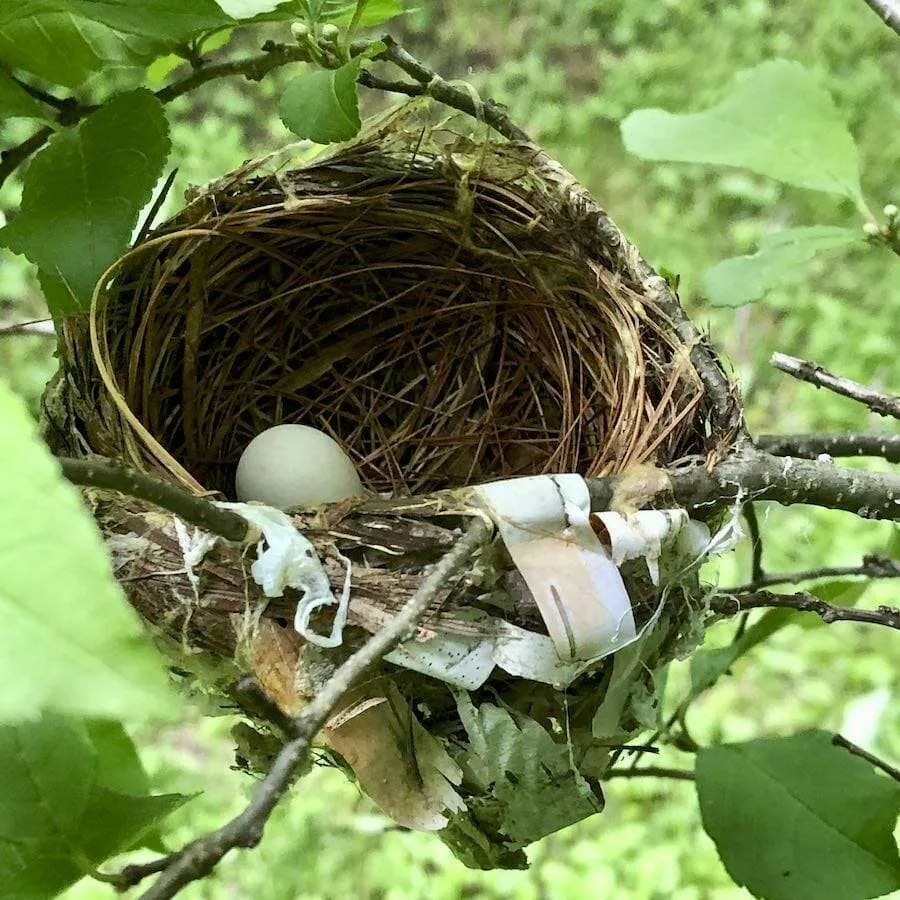
As an example, in our program at Southern CT State University, we have created the metaphor of occupation as an egg in a nest. The nest sits on a branch, on a tree, in a forest. We will be using this to help students relate all of the content we are teaching to occupation. For example, play, well, that topic is the egg. Clinical reasoning- that is a topic related to the branch of how OTs think. Completing an occupational profile, that is the branch of what OT’s do. IDEA as a law, that is part of the tree of the U.S. healthcare system (etc.). This will be used throughout our courses to continually orient students to the relationship between all of the topics being learned.
Practical strategies for bringing analogy and metaphor into your OT classroom:
- Start with lived experience. Ask students to describe their routines, roles, or rituals, then build metaphors from their own examples (e.g., “My morning routine is like setting the stage for a performance”).
- Use visual metaphors. Diagrams, sketchnotes, and mind maps can help make abstract ideas more tangible (try drawing the OTPF as an apartment building or layering client factors like sediment in a jar).
- Create anchor analogies. For foundational ideas, develop a class-wide metaphor and return to it throughout the semester (e.g., “Occupation is the thread that weaves through …….”).
- Encourage student-generated metaphors. Give students space to create their own analogies for key OT concepts—it’s a great formative assessment.
- Model use clinically. Share stories of how you’ve used metaphor or analogy in practice. (“I once told a teen that their rehab journey was like leveling up in a video game—it gave them a sense of progress and purpose.”)
Steps to Teaching Effectively Using Analogy and Metaphor
- Start with what students already know. Choose familiar examples or ideas (source analogs) that connect to students’ existing knowledge or life experience. This makes new concepts easier to grasp.
- Make the connections clear. Don’t just say “this is like that”—take the time to explain exactly how the parts of the familiar example relate to the new idea.
- Use multiple ways to show the structure. Support understanding with visuals (like diagrams), gestures (like pointing or miming), and clear spoken language. Reinforce how all examples fit into the same deeper pattern or concept.
- Connect ideas across domains. If you’re teaching something technical (like clinical reasoning), explain how the meaning of words or concepts maps onto the steps or procedures being used. Highlight the why, not just the how.
- Present comparisons clearly and cleanly. Use layout, visuals, and pacing to help students focus on the key similarities without being overwhelmed. Don’t make them work too hard to spot the connections.
- Encourage creative thinking once they’re ready. After students have built a solid understanding, give them space to make their own inferences, generate new analogies, or apply the concept in novel ways.
(Adapted from Gray & Holyoak)
Resources
Here are some resources to spark your metaphorical mind:
- Books
- Metaphors We Live By by George Lakoff & Mark Johnson – the classic on how metaphor shapes thought
- Teaching with the Brain in Mind by Eric Jensen – includes metaphor use as a cognitive teaching strategy
- The Art of Explanation by Lee LeFever – great tips on using simple language and analogies to teach complex ideas
- Metaphors We Live By by George Lakoff & Mark Johnson – the classic on how metaphor shapes thought
Final Thought
Analogies and metaphors don’t just help students understand OT—they help them feel it. They give color and texture to our professional identity and help our learners connect to the heart of what we do. So go ahead—paint a picture, spin a metaphor, build a bridge with words—and watch understanding unfold.
References
Ellul, M., & Bezzina, A. (2023). The Effectiveness of Analogy Learning as a Learning Practice Condition in Primary Physical Education. Malta Journal of Education, 4(2), 47-66.
Gess, A. H., Beltrame, F., Brivio, E., Tagliasco, V., Heboyan, V., De Leo, G., & D’Oria, M. (2020). Knowledge, use, and perceptions of metaphors among allied health faculty. Journal of allied health, 49(1), 45-52.
Gray, M. E., & Holyoak, K. J. (2021). Teaching by analogy: From theory to practice. Mind, Brain, and Education, 15(3), 250-263.
Hooper, B. R., Greene, D., & Sample, P. L. (2014). Exploring features of integrative teaching through a microanalysis of connection-making processes in a health sciences curriculum. Advances in Health Sciences Education, 19(4), 469-495.
Hooper, B., Molineux, M., & Wood, W. (2020). The subject-centered integrative learning model: A new model for teaching occupational therapy’s distinct value. Journal of Occupational Therapy Education, 4(2), 1.
Hooper, B., Krishnagiri, S., Price, P., Taff, S. D., & Bilics, A. (2018). Curriculum-level strategies that US occupational therapy programs use to address occupation: A qualitative study. The American Journal of Occupational Therapy, 72(1), 7201205040p1-7201205040p10.
Richland, L. E., & McDonough, I. M. (2010). Learning by analogy: Discriminating between potential analogs. Contemporary Educational Psychology, 35(1), 28-43.
Zafran, H. (2020). A narrative phenomenological approach to transformative learning: lessons from occupational therapy reasoning in educational practice. The American Journal of Occupational Therapy, 74(1), 7401347010p1-7401347010p6.
 The Wizard of OT
Leave a comment