
What OT Educators Can Learn from “Teach Like a PIRATE”
Heather Miller Kuhaneck, PhD OTR/L FAOTA
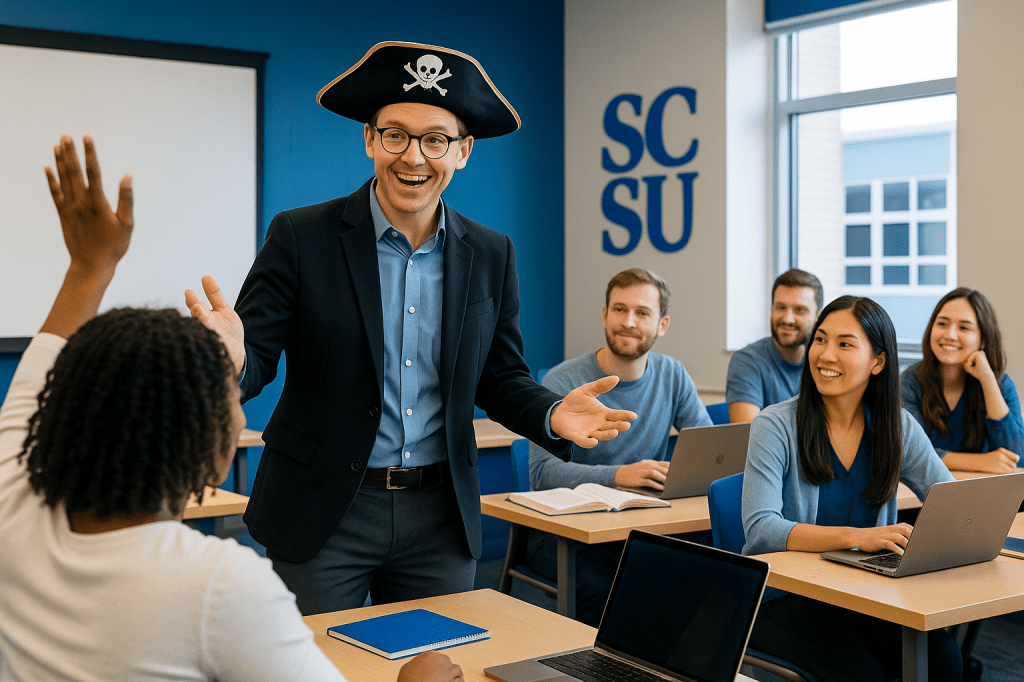
At first glance, Dave Burgess’s Teach Like a PIRATE might seem like a book designed solely for K–12 classrooms. And it is. But if you’re willing to sail a little off the edge of the map, this passionate approach to education has plenty to offer us in occupational therapy (OT) education too.
This week’s Wisdom Wednesday is about how we, as faculty in graduate health professions, can borrow from Burgess’s PIRATE philosophy to energize our teaching—and maybe transform our students in the process.
PIRATE Teaching: A Framework for Bold Educators
Burgess’s acronym PIRATE stands for:
- Passion
- Immersion
- Rapport
- Ask & Analyze
- Transformation
- Enthusiasm
These are not just principles for classroom management—they’re reminders that students (at any level) respond best when we teach with heart, with energy, and with intention.
Passion (P): Content, Professional, Personal
Burgess identifies three kinds of passion that every teacher can tap into:
- Content passion: What topics do you love to teach in OT? Activity analysis? Play-based assessment? The Intentional Relationship Model?
- Professional passion: What roles or duties light you up? Advising? Faculty mentoring? Program design?
- Personal passion: What hobbies or outside interests do you bring into the classroom (quilting metaphors, anyone)?
Even in grad school, students crave connection. When we infuse our lessons with our own excitement, we model what it looks like to be a lifelong learner.
Immersion (I): Be All In
Being immersed means showing up fully—not just delivering a lecture, but being present and involved. In our OT classrooms, that might look like:
- Sitting in on student labs as a participant, not a supervisor
- Attending student-led presentations and giving authentic feedback
- Getting curious about their passions and aspirations
Rapport (R): The Foundation of Trust
In OT practice, therapeutic use of self is everything. In OT education? It’s no different.
We can’t expect our students to take creative or clinical risks if they don’t feel safe. Rapport is more than being nice—it’s about building a space of psychological safety, mutual respect, and shared investment.
Ask & Analyze (A): Reflective Teaching is Effective Teaching
This is where PIRATE becomes a growth mindset tool. After each class, ask yourself:
- What sparked engagement?
- What fell flat?
- What could I try next time?
Reflection isn’t just for students—it’s how we refine our craft.
Transformation (T): Beyond “Delivering Content”
Burgess says the goal is not just to teach—it’s to transform. That means helping students see their future selves in this work. It means teaching occupation-based reasoning in a way that feels real, not rote.
In our OT curriculum, transformation might look like:
- Turning a case study into an ethical courtroom drama
- Linking a play-based assessment lab to students’ own childhood occupations
Enthusiasm (E): Bring the Energy (Even When You’re Tired)
No one feels 100% every day—but Burgess reminds us that students deserve a teacher who shows up with intention. Enthusiasm, even when “faked” at first, often becomes genuine once you’re in motion.
Getting OT Students Hooked on Learning
One of the most actionable parts of Teach Like a PIRATE is Burgess’s “hook” system—a collection of ideas to ignite student engagement. These were designed for K–12, but with a bit of tweaking, they’re brilliant in grad school too.
Here are just a few:
- The Art Hook – Ask students to sketch a model of the brachial plexus, use pipe cleaners to build the vestibular system, or use visual metaphors to express the IRM modes.
- The Music Hook – Let students create a playlist that captures different intervention styles or occupational outcomes, or write songs to familiar tunes that help them remember the functions of the parts of the brain.
- The Kinesthetic Hook – Create human flow charts for OT related procedures, act out body processes (action potential propagation????)
- The Mystery Bag Hook – Use a sealed envelope with clues to introduce a case study or a debate about an ethical dilemma.
- The Magic Show Hook – Use a surprising prop or unexpected role-play to introduce difficult topics like reimbursement.
- The Teaser Hook – Announce something mysterious: “Next class, come prepared to meet your most unexpected client yet…”
These hooks aren’t about being gimmicky—they’re about being memorable! And let’s face it: when students in graduate school are juggling jobs, families, and clinical anxiety, they need learning that sticks.
Adapting PIRATE for OT & Higher Ed
Of course, OT students aren’t in 5th grade. They are future health professionals who need rigor, structure, and high expectations. But engagement doesn’t have to be sacrificed in the name of professionalism.
So here’s the call to action:
- Use PIRATE not to simplify, but to humanize your teaching.
- Let hooks serve as learning enhancers, not distractions.
- Show your students what passion and creativity looks like in practice—so they can bring it to their future clients.
Reference:
Burgess, D. (2012). Teach like a PIRATE: Increase student engagement, boost your creativity, and transform your life as an educator. Dave Burgess Consulting, Inc. https://daveburgess.com/
 The Wizard of OT
Leave a comment