
The Warm Demander: Balancing Compassion and High Expectations in OT Education
What is a “Warm Demander”?
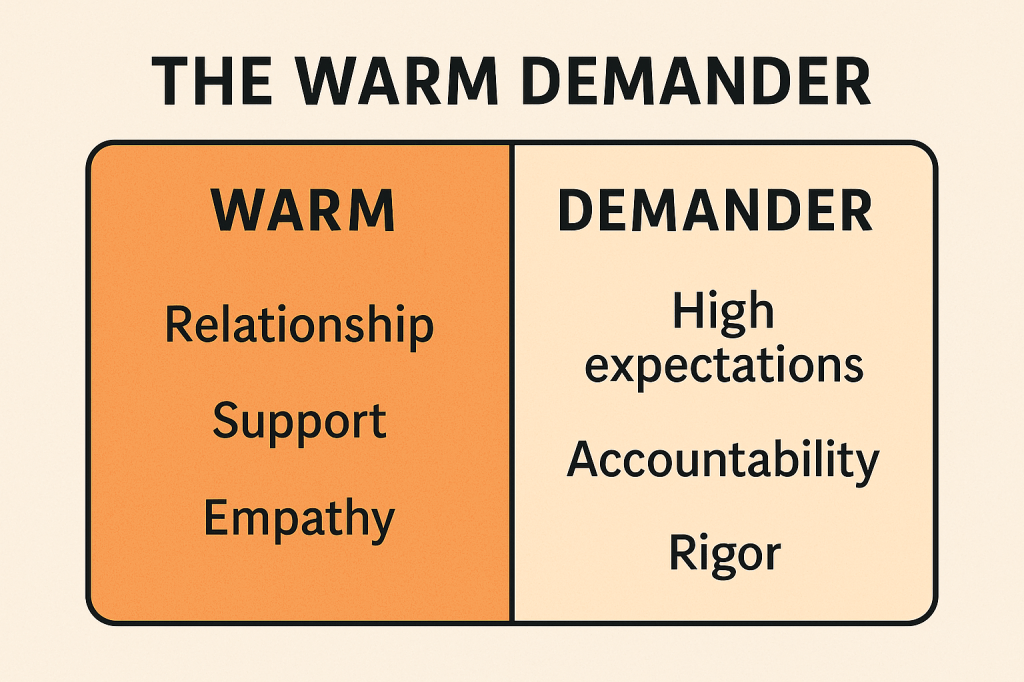
The term warm demander comes from K–12 education research but translates beautifully into occupational therapy (OT) education. A warm demander is an educator who pairs deep care for their students with equally high expectations. These educators build strong, trusting relationships, make sure students feel seen, respected, and supported, and at the same time, refuse to lower the bar for academic and professional excellence. In OT education, this approach means communicating belief in students’ abilities, offering encouragement and resources, and holding them accountable to professional behaviors, evidence-based reasoning, and clinical competence.
Why Use the Warm Demander Approach in OT Education?
OT students face the dual challenge of mastering rigorous academic content and developing the interpersonal, reflective, and ethical skills that make them effective therapists. If faculty are “all warmth” with no accountability, students may feel supported but underprepared. If faculty are “all demand” with little relationship, students may feel pressured, anxious, or disconnected.
The warm demander stance strikes the balance:
- Fosters belonging – Students know their professors truly care.
- Encourages growth – High expectations push students beyond comfort zones.
- Models therapeutic use of self – Faculty demonstrate how to combine empathy with boundaries, a skill students will need in client care.
- Prepares students for the profession – OT practice requires resilience, accountability, and compassion in equal measure.
How to Use the Warm Demander Approach in Your OT Classroom
- Build authentic relationships. Learn your students’ names, goals, and challenges. Show interest in their growth as future practitioners.
- Set clear expectations. Provide transparent grading rubrics, behavioral expectations, and standards.
- Communicate belief in students’ abilities. Remind them, “I push you because I know you can rise to this challenge.”
- Provide scaffolding and feedback. Support struggling students with concrete strategies while holding them accountable for effort and improvement.
- Model TUOS. Just as students must learn to balance empathy with therapeutic boundaries, professors can show this balance in their teaching stance.
- Hold firm when needed. Address lateness, incomplete work, or unprofessional behaviors with consistency and care—making it clear that accountability is an act of support, not punishment.
Supportive Evidence: The Power of Small Wins
Research suggests that it’s small wins that keep students motivated. A study with elementary students found that those who were given a few easier math problems mixed in with difficult ones were twice as likely to enjoy the activity and to want to try more challenging problems compared to peers who only received difficult items. In this group of 570 third and sixth graders, the researchers found that the placement of these small successes mattered: students who experienced an early win or ended on a high note showed the most motivation.
When students feel small bursts of accomplishment amid challenges, they may be more likely to persist, engage deeply, and embrace the growth that comes from struggle. Warm demanders can use this evidence to both challenge AND support as classroom activities and assessments are created.
Finn, B., Miele, D. B., & Wigfield, A. (2025). Investigating the remembered success effect with elementary and middle school students. Journal of Educational Psychology, 117(2), 308–335. https://doi.org/10.1037/edu0000846
As and FYI, the concept of warm demanders also meshes well with some of the Wise Interventions supported by Walton and colleagues.
Walton, G. M., & Wilson, T. D. (2018). Wise interventions: Psychological remedies for social and personal problems. Psychological Review, 125(5), 617–655. https://doi.org/10.1037/rev0000115
For More Information:
Web
https://www.warmdemanders.com/
https://www.edutopia.org/blog/warm-demander-equity-approach-matt-alexander
Books
- Ware, F. (2024). Warm Demander Teachers: Healthy, Whole, and Transformational. Corwin Press.
Articles
- Bondy, E., & Ross, D. D. (2008). The teacher as warm demander. Educational Leadership, 66(1), 54-58.
- Bondy, E., Ross, D. D., Hambacher, E., & Acosta, M. (2013). Becoming warm demanders: Perspectives and practices of first year teachers. Urban Education, 48(3), 420-450.
- Hinnant-Crawford, B., Bergeron, L., Virtue, E., Cromartie, S., & Harrington, S. (2023). Good teaching, warm and demanding classrooms, and critically conscious students: Measuring student perceptions of asset-based equity pedagogy in the classroom. Equity & Excellence in Education, 56(3), 306-322.
- Kleinfeld, J. (1975). Effective teachers of Eskimo and Indian students. The School Review, 83(2), 301-344. (This is the author who coined the term).
- Kleinfeld, J. S. (1974). Effective teachers of Indian and Eskimo high school students. Cultural influences in Alaskan Native education, 11-37. (This is the author who coined the term).
- Safir, S. (2019). Becoming a Warm Demander. Educational Leadership, 76(6), 64-69.
 The Wizard of OT
Leave a comment