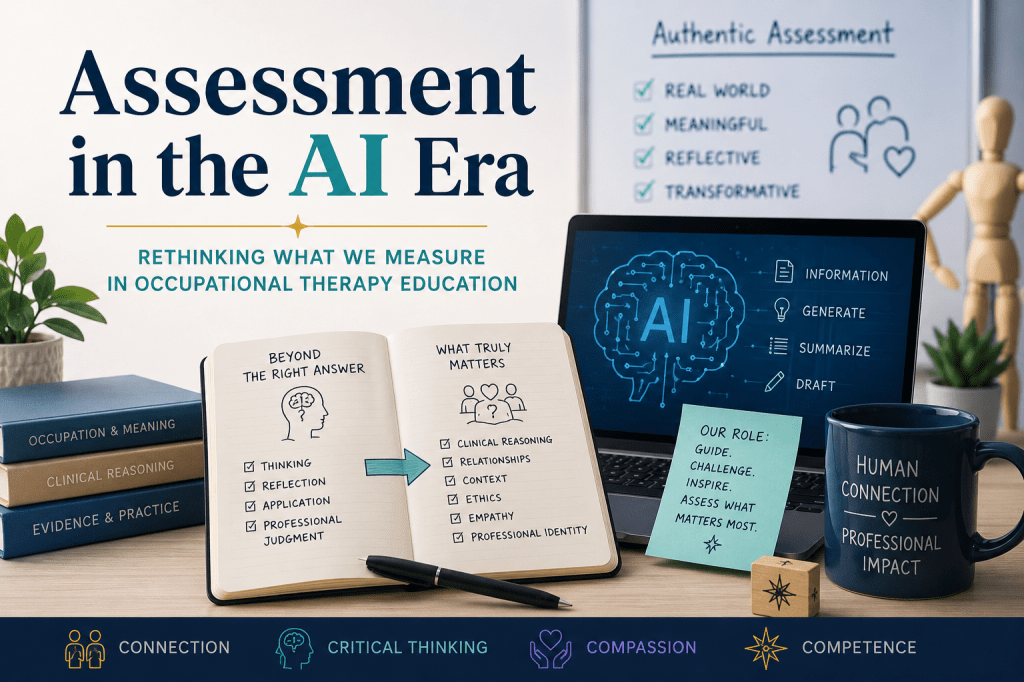
Rethinking What We Measure in Occupational Therapy Education
Heather Kuhaneck 5-20-26
Introduction
Artificial intelligence has arrived in higher education faster than many of us anticipated. Tools such as OpenAI’s ChatGPT and similar generative AI platforms can now summarize articles, generate discussion posts, write essays, create study guides, answer test questions, and even simulate clinical reasoning. For faculty, this rapid shift has created understandable anxiety around academic integrity, authentic learning, and the future of assessment.
But perhaps the more important question is not, “How do we stop students from using AI?” Instead, we may need to ask: What kinds of learning experiences and assessments are truly worth measuring in an AI-enabled world?
Occupational therapy education has an opportunity to respond thoughtfully rather than reactively. Our profession values clinical reasoning, therapeutic relationships, contextual thinking, collaboration, ethical decision-making, and occupation-centered practice—human capacities that cannot simply be outsourced to a machine. This moment invites us to reconsider not only how we assess students, but what we believe matters most in becoming an occupational therapist.
What Is “Assessment in the AI Era”?
Assessment in the AI era refers to the redesign of educational evaluation methods in response to widespread access to generative AI tools. Traditional assignments that are increasingly vulnerable to AI completion. At the same time, AI can also serve as a meaningful support tool for brainstorming, studying, drafting, and feedback when used intentionally and ethically.
The challenge for educators is to distinguish between:
- tasks that merely produce a finished product,
- and assessments that reveal authentic thinking, reasoning, reflection, and professional growth.
This does not necessarily mean abandoning written assignments or banning AI entirely. Instead, it means designing assessments that:
- prioritize process over product,
- require application and contextual reasoning,
- involve human interaction,
- emphasize reflection and metacognition,
- and connect directly to professional practice.
In occupational therapy education, this shift aligns naturally with competency-based learning, experiential learning, and authentic assessment approaches already valued within health professions education.
Why Rethink Assessment? Traditional Assessments Often Measure Compliance More Than Learning
Many traditional academic tasks were designed during a time when access to information was limited. Students demonstrated competence by recalling and reproducing knowledge. Today, information is instantly accessible, and AI tools can generate polished responses within seconds.
If an assignment can be completed effectively by AI without requiring genuine understanding, reflection, or decision-making, we may need to ask whether the assignment was measuring meaningful learning in the first place.
Research in higher education has increasingly emphasized that deep learning occurs when students actively engage in retrieval, application, discussion, synthesis, and reflection rather than passive memorization.
Authentic Assessment Better Reflects Professional Practice
Healthcare professionals do not practice by completing isolated multiple-choice tests without resources. In real clinical environments, practitioners consult references, collaborate with colleagues, seek evidence, adapt to context, and justify decisions.
Authentic assessment attempts to mirror these real-world demands. Examples include:
- case-based reasoning,
- oral examinations,
- simulations,
- competency demonstrations,
- reflective analysis,
- collaborative problem-solving,
- and portfolio development.
Studies in health professions education suggest that authentic assessments improve transfer of learning, professional reasoning, and long-term retention compared to decontextualized testing alone.
For occupational therapy specifically, authentic assessment is particularly important because practice depends heavily on therapeutic use of self, contextual adaptation, occupation-centered thinking, and collaborative clinical reasoning.
AI Makes Human Skills More Valuable, Not Less
Ironically, the growth of AI may increase the importance of uniquely human professional skills.
Patients and clients do not simply need information. They need:
- empathy,
- trust,
- communication,
- ethical judgment,
- creativity,
- flexibility,
- cultural humility,
- and therapeutic relationships.
These are precisely the areas where occupational therapy excels.
As AI becomes more integrated into healthcare and education, our assessments should increasingly emphasize:
- reasoning rather than recall,
- adaptability rather than memorization,
- and reflective professional identity rather than performance alone.
How Can Faculty Adapt Assessment Thoughtfully?
Shift From “AI-Proof” to “AI-Aware”
In an earlier post on this blog, we wrote about AI proofing assignments. But, now, attempting to completely eliminate AI use may become increasingly unrealistic. Instead, faculty can create transparent expectations around acceptable AI use while designing assignments that still require authentic student engagement.
For example:
- AI may help brainstorm intervention ideas, but students must justify clinical reasoning, critique the AI output, apply ideas to a specific client context, and reflect on ethical implications.
This transforms AI from a shortcut into a learning tool.
Use More Authentic and Performance-Based Assessments
Assessments that involve live interaction, demonstration, or contextual adaptation are much more difficult to outsource.
Examples in OT education may include:
- role-played occupational profiles,
- client education demonstrations,
- group treatment planning,
- simulated documentation,
- oral case defense,
- activity analysis,
- community-based projects,
- or competency assessment stations.
These forms of assessment better reflect actual professional practice while also increasing student engagement.
Assess Clinical Reasoning Explicitly
Students should not only provide answers—they should explain why they made decisions.
Faculty can ask students to:
- justify intervention choices,
- compare alternatives,
- identify contextual factors,
- discuss ethical concerns,
- explain what evidence influenced decisions,
- or reflect on uncertainty.
This makes thinking visible.
Clinical reasoning is one of the most important skills in occupational therapy and one of the least likely to be replaced by AI.
Incorporate Reflection and Metacognition
Reflection remains deeply human. Students can be asked to discuss:
- what challenged them,
- how their thinking changed,
- where they struggled,
- what biases they noticed,
- or how they would approach the situation differently next time.
Reflective practice supports professional identity formation and lifelong learning—both essential in healthcare professions.
Focus on Feedback and Growth
If AI can generate polished first drafts, the role of education may increasingly shift toward coaching, feedback, revision, and iterative growth.
Assessment systems such as:
- standards-based grading,
- specifications grading,
- competency-based assessment,
- and opportunities for revision and resubmission
may better support meaningful learning than one-time high-stakes grading systems.
These approaches encourage mastery, persistence, and reflection rather than point accumulation.
Final Thoughts
The rise of artificial intelligence does not signal the end of meaningful education. Instead, it challenges us to become more intentional about what we value, what we assess, and how we define competence.
Occupational therapy education is uniquely positioned for this moment. Our profession has always emphasized context, human connection, creativity, adaptability, and meaningful participation in life. These are not easily automated skills.
Perhaps the goal is no longer to design assessments that AI cannot touch. Perhaps the goal is to design learning experiences so deeply human, reflective, contextual, and relational that AI alone will never be enough.
References
Brown, P. C., Roediger, H. L., & McDaniel, M. A. (2014). Make it stick: The science of successful learning. Harvard University Press.
Gulikers, J. T. M., Bastiaens, T. J., & Kirschner, P. A. (2004). A five-dimensional framework for authentic assessment. Educational Technology Research and Development, 52(3), 67–86.
Lang, J. M. (2020). Distracted: Why students can’t focus and what you can do about it. Basic Books.
Mueller, J. (2018). Authentic assessment toolbox. Retrieved from Authentic Assessment Toolbox https://jonfmueller.com/toolbox/
Trust, T., Whalen, J., & Mouza, C. (2023). Editorial: ChatGPT: Challenges, opportunities, and implications for teacher education. Contemporary Issues in Technology and Teacher Education, 23(1), 1–23.


Leave a Reply